
FUE Hair Transplant: Process, Cost, and Recovery
Traditional hair transplants required cutting a long strip of scalp from the back of the head to extract hair grafts, leaving a noticeable scar and requiring a lengthy recovery. The development of the FUE technique largely overcame these limitations, making hair transplantation a far more accessible procedure.
What is a FUE Hair Transplant?
FUE, which stands for Follicular Unit Extraction, is a hair transplant technique that involves extracting hair follicles one graft at a time using a micro-punch tool. This results in smaller wounds and a faster recovery compared to the older FUT (Follicular Unit Transplantation) technique, which requires cutting a long strip of scalp from the back of the head to harvest grafts.
Once extracted, the grafts are placed in a preservation solution to maintain their quality. The doctor then creates recipient sites and implants the follicles one by one using forceps.
Throughout the FUE procedure, local anesthesia is administered to ensure the patient remains comfortable and pain-free. A tumescent solution — a saline mixture containing local anesthetic and epinephrine — is also injected into the scalp. This causes the tissue to expand temporarily, which minimizes bleeding and allows for greater precision during graft placement.
How Much Does a FUE Hair Transplant Cost?
Dr. PAUL Hair Clinic offers two pricing options for FUE hair transplants: per-graft pricing and a flat-rate promotion.
For per-graft pricing, the rate starts at THB 89 per graft. Based on common graft quantities, the costs are as follows:
- 1,000 grafts: THB 89,000
- 2,000 grafts: THB 178,000
- 3,000 grafts: THB 267,000
For most patients, the flat-rate promotion offers better value, starting at just THB 75,000 regardless of the number of grafts. It also comes with a range of added benefits and installment payment options with participating credit cards.
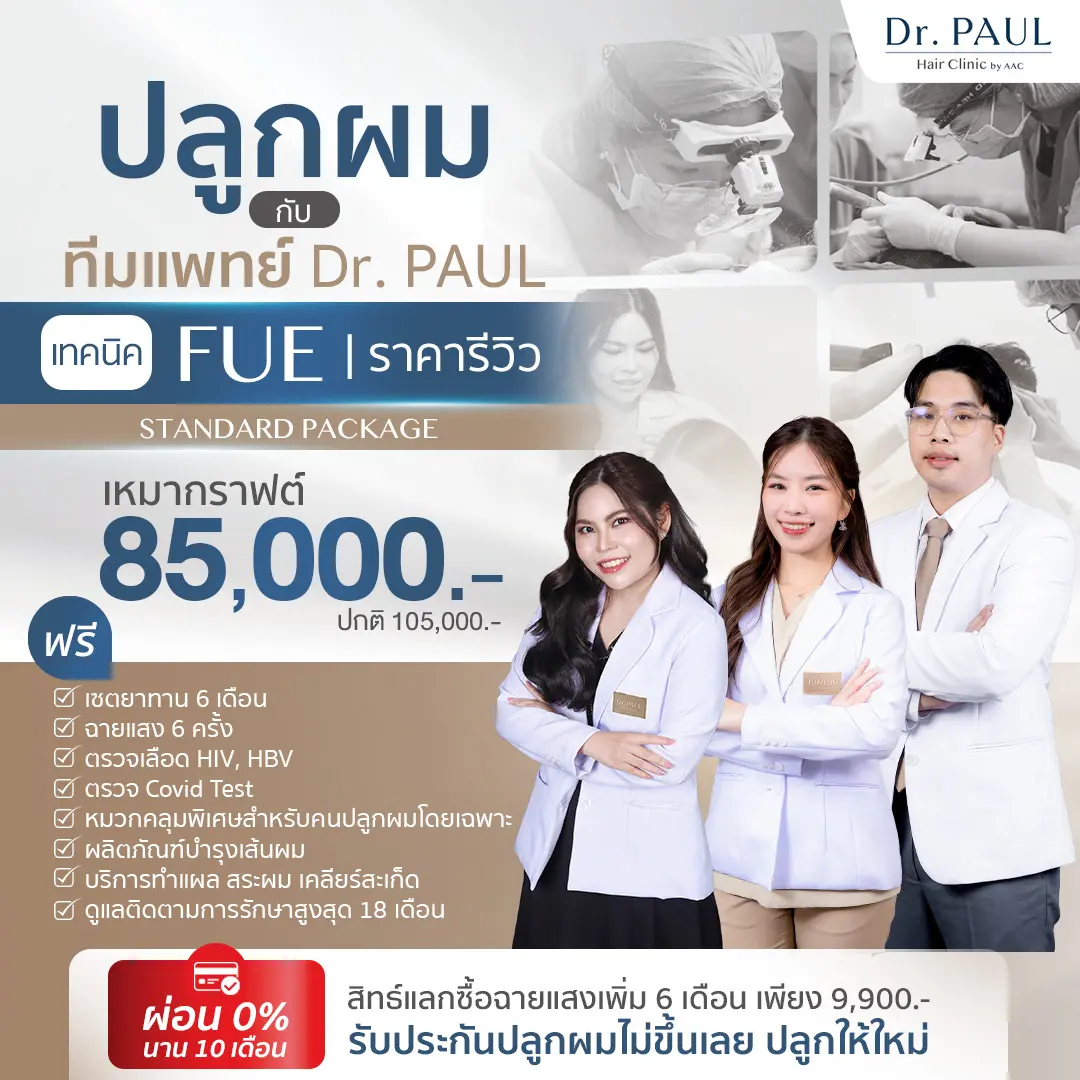
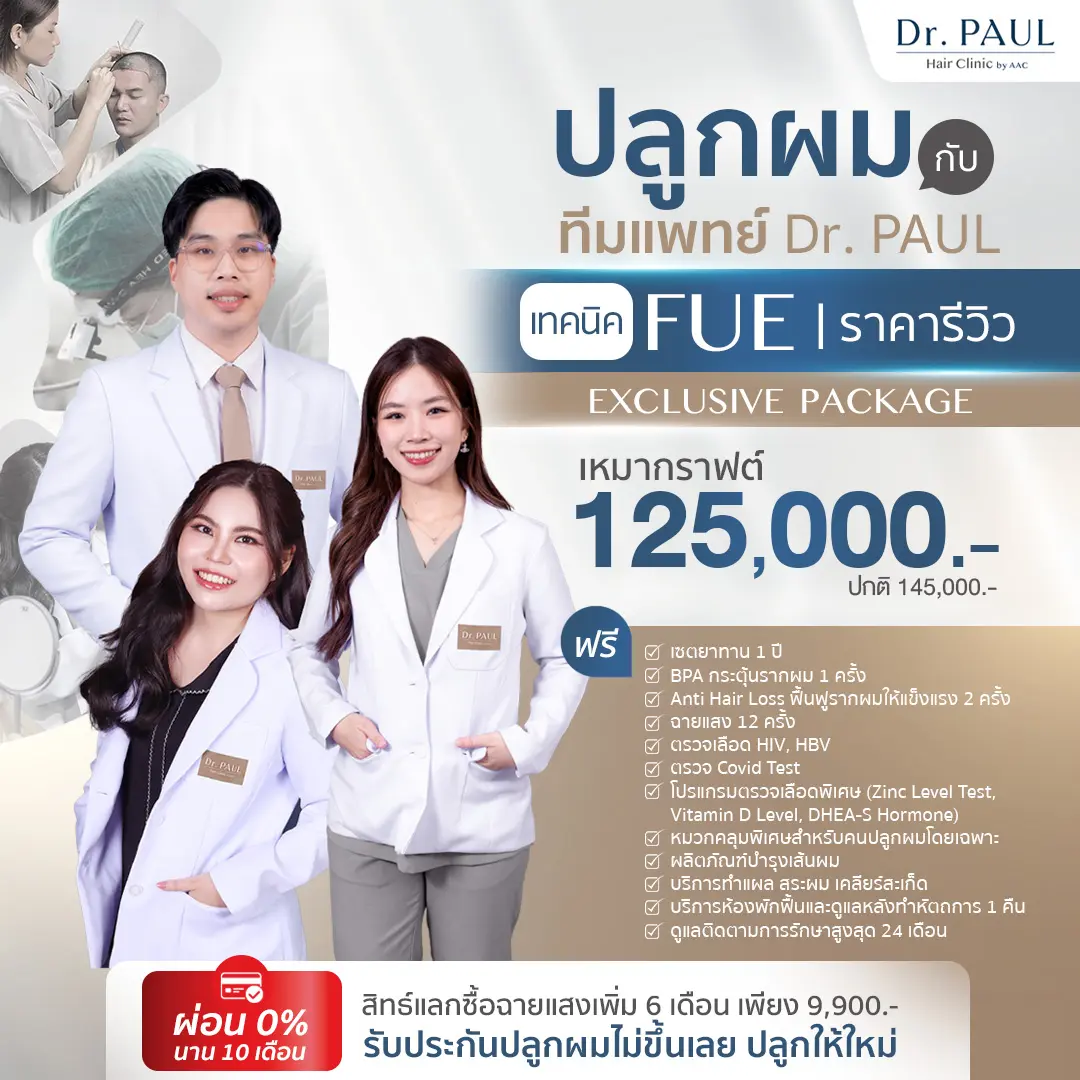
*Prices and promotions may be subject to change. Please confirm with the clinic directly for the most up-to-date information.
FUE Hair Transplant Procedure
The FUE hair transplant procedure involves the following steps:
- Consultation: The patient discusses their concerns with the doctor, who evaluates whether the donor hair is strong and sufficient for transplantation.
- Pre-procedure preparation: On the day of the procedure, a medical assistant thoroughly washes the patient’s hair. The doctor then designs the hairline to look natural and complement the patient’s facial structure.
- Shaving the donor area: The back of the head is shaved before the FUE procedure. The doctor then injects a saline-based local anesthetic to soften the scalp and facilitate easier graft extraction.
- Graft extraction: The doctor extracts hair follicles one graft at a time, distributed evenly across the donor area to avoid visible thinning, until the pre-assessed number of grafts has been collected.
- Graft preservation: The extracted grafts are placed in a preservation solution to maintain their quality.
- Recipient site preparation: The doctor administers local anesthesia to the recipient area and uses a micro-punch to create recipient sites for the new follicles.
- Graft implantation: Using forceps, the doctor carefully implants each graft into the designated sites until all grafts have been placed.
FUE Hair Transplant Aftercare
The following is a general aftercare guideline for FUE hair transplant patients. Always consult your doctor for personalized advice.
- Take prescribed medications: All medications should be taken as prescribed by the doctor to help manage and prevent side effects. These typically include pain relievers, anti-inflammatory medication, antibiotics, and hair growth medication, depending on each individual’s needs.
- Avoid touching the transplanted area: The transplanted area should not be touched, scratched, or picked at, and care should be taken not to bump or knock the head against anything, as this may damage the grafts.
- Adjust sleeping position: Sleeping on the back using a U-shaped neck pillow or an inflatable donut pillow helps prevent the transplanted area from coming into direct contact with the pillow or any surface, while also helping elevate the head to reduce swelling. This position should be maintained for at least the first 7–10 days, or until the doctor advises otherwise.
- Wash hair correctly: Hair washing should be avoided for the first 24–48 hours after the procedure. After that, gentle washing can begin as per doctor’s instructions, using saline solution or clean water in a spray bottle to mist the area, along with a mild shampoo. A showerhead or high-pressure water should not be used, and the transplanted area should not be rubbed or scrubbed. Water should be allowed to flow gently over the scalp, then patted dry with a clean, soft towel.
- Avoid strenuous activity: Exercise and strenuous activities should be avoided for at least 2 weeks after the procedure, as these may affect grafts that have not yet fully healed and increase the risk of infection from sweat.
- Avoid sun exposure: The transplanted area should be kept out of direct sunlight for at least a month to prevent UV damage.
- Avoid alcohol: Alcoholic beverages such as spirits, beer, or wine should be avoided for at least 1–2 weeks after the procedure, as alcohol can slow blood clotting, increase swelling, raise the risk of bleeding, and delay healing.
- Avoid smoking: Smoking should be avoided for at least 2–4 weeks after the procedure, as substances in cigarettes, vapes, and shisha interfere with blood circulation, reducing the oxygen and nutrients the grafts receive and slowing down healing. Secondhand smoke should also be avoided, as it causes the same harmful effects.
- Maintain a nutritious diet: The body should receive adequate energy, protein, iron, zinc, vitamin C, biotin, and other essential nutrients to support wound healing and graft recovery.
- Avoid chemical treatments and heat styling: Avoid coloring, perming, straightening, or applying any chemical treatments to the hair for at least 3–6 months after the procedure, or until the doctor confirms it is safe to do so, as heat and chemicals may damage grafts that have not yet fully recovered.
- Consult the doctor before using hair products: Before using any serums, vitamins, or hair growth products, always consult the doctor first to avoid any potential adverse effects.
- Attend follow-up appointments: All scheduled follow-up appointments should be attended for ongoing assessment and care. Dr. PAUL Hair Clinic also provides complimentary wound care, hair washing, and scab removal services at intervals determined by the doctor.
FUE Hair Transplant Recovery Timeline
Hair transplanted using the FUE technique typically begins to grow around 3–4 months after the procedure, with full results visible between 12 and 18 months. The general timeline is as follows:
- 1–3 days: Mild redness and swelling may occur, and the grafts are extremely fragile during this time. Patients should sleep with their head elevated to reduce swelling and avoid touching or rubbing the area to prevent dislodging the grafts.
- 4–14 days: Tiny scabs form around the extracted and implanted follicles. Patients can gently wash their hair according to their doctor’s specific instructions, but should generally continue avoiding touching or rubbing the area until day 14. Most scabs fall off naturally between days 10 and 14. Patients should never pick, scratch, or aggressively force them off, though they may choose to have the clinic help clear the scabs for them using a gentle, professional method.
- 2–8 weeks: Some patients may experience temporary shedding of the transplanted hair during this period. This is a normal post-surgical response known as shock loss, caused by the body’s reaction to trauma or inflammation.
- 3–4 months: The transplanted hair begins to regrow, initially appearing fine and thin, similar to baby hair.
- 6–7 months: The new hair becomes noticeably longer and stronger.
- 9–12 months: Most patients begin to see clearly visible results in line with their expectations, both in terms of thickness and hair strength.
- 12–18 months: Full results are typically visible during this period, with the transplanted hair growing strong and looking natural.
How to Choose the Right Clinic for FUE Hair Transplant
When choosing a clinic for a FUE hair transplant or any other technique, the following key factors should be considered:
- Doctor’s expertise: The doctor performing the transplant must have dedicated training and direct experience in hair transplantation, which can be assessed through their background and portfolio.
- Transplant team’s skill: Hair transplantation is a team procedure, making the skill and experience of the transplant team just as important as that of the doctor.
- Up-to-date technology: Modern technology and techniques can help minimize errors and produce more consistent results, but should always be complemented by a skilled doctor and transplant team.
- Hygiene and facility standards: The clinic must be legally licensed and maintain high hygiene standards, as these directly affect the safety of the procedure.
- Documented results: One of the most telling indicators of a doctor and their team’s skill is their documented transplant results, in the form of before-and-after photos and videos.
At Dr. PAUL Hair Clinic, we meet all of the above criteria. In addition, we bring an expert hair design approach that delivers natural-looking results, extensive experience handling revision cases from other clinics, and recognition as one of Thailand’s top 5 hair transplant clinics, with locations across 6 provinces.
Conclusion
FUE is a hair transplant technique that extracts hair follicles one graft at a time, resulting in smaller wounds and a faster recovery compared to older techniques such as FUT. This key advantage has made FUE one of the most popular hair transplant techniques available today, and it also serves as the foundation for newer techniques such as DHI and LEAN.
For pricing, FUE hair transplants at Dr. PAUL Hair Clinic are available through a flat-rate promotion starting at just THB 75,000, regardless of the number of grafts.
FUE Hair Transplant FAQ
Frequently asked questions about FUE hair transplants, answered by Dr. PAUL Hair Clinic.
What Is the Difference Between FUT and FUE Hair Transplant?
FUT is the older of the two techniques, involving the removal of a long strip of scalp from the back of the head to harvest grafts. FUE, on the other hand, extracts hair follicles one graft at a time. The key differences between the two are as follows:
| Comparison | FUT Hair Transplant | FUE Hair Transplant |
|---|---|---|
| Graft Extraction | Involves cutting a long strip of scalp from the back of the head to harvest grafts | Involves extracting hair follicles from the back of the head one graft at a time |
| Wound Size | Larger wound | Much smaller wounds |
| Discomfort | More painful | Less painful |
| Recovery | Longer recovery | Faster recovery (most patients recover in just 2–3 days) |
| Popularity | Less popular | More popular |
| Price | Typically less expensive | Typically more expensive |
| Advantages | Often takes less time, making it potentially suitable for high graft count cases. Generally less expensive than FUE | Very small wounds with minimal visible scarring after recovery, even with short hairstyles. Less discomfort and faster recovery compared to FUT |
| Disadvantages | Larger wound and longer recovery compared to FUE. A visible linear scar may remain at the back of the head, particularly with very short hairstyles such as a buzz cut | Takes longer to perform and is generally more expensive than FUT |
Thanks to its smaller wounds, minimal discomfort, and faster recovery, FUE has become more popular than FUT. Newer techniques such as DHI, LEAN, LEAN Non-Shaven, and LEAN Long Hair are all built upon the same core principle of extracting grafts one at a time, making FUE the foundation of modern hair transplantation.
What Is the Difference Between DHI and FUE Hair Transplant?
The DHI (Direct Hair Implantation) technique is an evolution of the FUE method. Its key difference is a specialized implanter tool that can puncture and insert hair grafts in a single step, so there’s no need to pre-create recipient sites like in FUE. This tool also gives doctors finer control over the direction, angle, and depth of each hair implanted.
| Comparison | DHI Hair Transplant | FUE Hair Transplant |
|---|---|---|
| Recipient Site Creation | No need to pre-create recipient sites | Requires pre-creating recipient sites |
| Implanter Tool | Uses a DHI Implanter (also called a Choi Implanter Pen), which can puncture and implant in a single tool with high precision | Typically uses forceps to implant grafts |
| Wound Size | Usually smaller | Small |
| Discomfort | Usually less painful | Low pain |
| Recovery | Usually faster recovery | Fast recovery |
| Popularity | Less widespread, but steadily gaining popularity | Widely popular |
| Price | Usually higher | Usually more affordable |
| Advantages | No need to pre-create recipient sites. The specialized pen allows for more precise control over direction, angle, and depth, which often results in smaller wounds, less pain, and faster recovery compared to FUE. Well suited for work that requires extra precision, such as hairline design | More affordable than DHI. Because grafts are harvested one at a time, wounds remain small, pain is minimal, and recovery is quick, meeting the needs of most patients. A suitable choice for those seeking a reliable, cost effective option |
| Disadvantages | Usually more expensive than FUE | Requires pre-creating recipient sites and offers less precision and control compared to DHI |
What Causes FUE Hair Transplant Failure?
Hair failing to grow after an FUE hair transplant can result from several factors, including:
- Lack of expertise from the doctor and surgical team: A successful hair transplant depends on precision at every step, including harvesting the grafts, preserving graft quality, and setting the correct angle and depth for implantation. If the doctor and team lack sufficient skill, the grafts may fail to grow as expected.
- Unsuitable health condition of the patient: Certain diseases and health conditions, such as uncontrolled diabetes, autoimmune disorders, and certain cardiovascular conditions, can affect graft survival rates. That’s why patients should undergo a thorough medical history review and health screening before the procedure.
- Improper aftercare following the procedure: Graft survival also depends on how well patients care for themselves after the transplant. Behaviors that can negatively affect results include smoking, drinking alcohol, inadequate hygiene practices, etc.
Does FUE Hair Transplant Have Side Effects?
In general, the FUE hair transplant technique causes very few side effects, as it is a minor surgical procedure that results in very small wounds. Possible temporary side effects include swelling and bruising at the wound sites, scalp swelling from anesthesia and fluids used during the procedure, and scalp acne caused by blocked hair follicles.
What Other Hair Transplant Techniques Does Dr. PAUL Hair Clinic Offer?
Beyond FUE and DHI, Dr. PAUL Hair Clinic also offers the LEAN technique (Dr. PAUL’s Technique), developed by Dr. Paul himself. This method adds an extra step of trimming excess fat from the hair grafts and uses specialized implanter tools suited to each area of the scalp. As a result, it produces smaller wounds, less swelling and bruising, and faster recovery than standard techniques, while also allowing hair to be implanted more densely for a more natural looking result.
For those who prefer a hair transplant without shaving, Dr. PAUL Hair Clinic also offers LEAN Non Shaven (where the transplanted grafts are trimmed short) and LEAN Long Hair (a technique that keeps hair at its original length, so patients can see long hair immediately after the procedure), both of which build on the strengths of the LEAN technique.
Can You Get a Hair Transplant Without Shaving?
A hair transplant doesn’t always require shaving. At Dr. PAUL Hair Clinic, patients can choose from two non-shaven techniques:
- LEAN Non-Shaven trims only the donor hair in scattered sections, rather than shaving the entire area, so the transplanted grafts come out short.
- LEAN Long Hair uses donor hair from the back and sides of the head at its original length, with only minimal trimming to blend it with the recipient area. Hair appears long immediately after the procedure, so it’s barely noticeable to others that a transplant took place.
Both techniques are based on the LEAN method, so they share the same core benefits: small wounds, minimal swelling and bruising, fast recovery, dense hair placement, and highly natural looking results.